
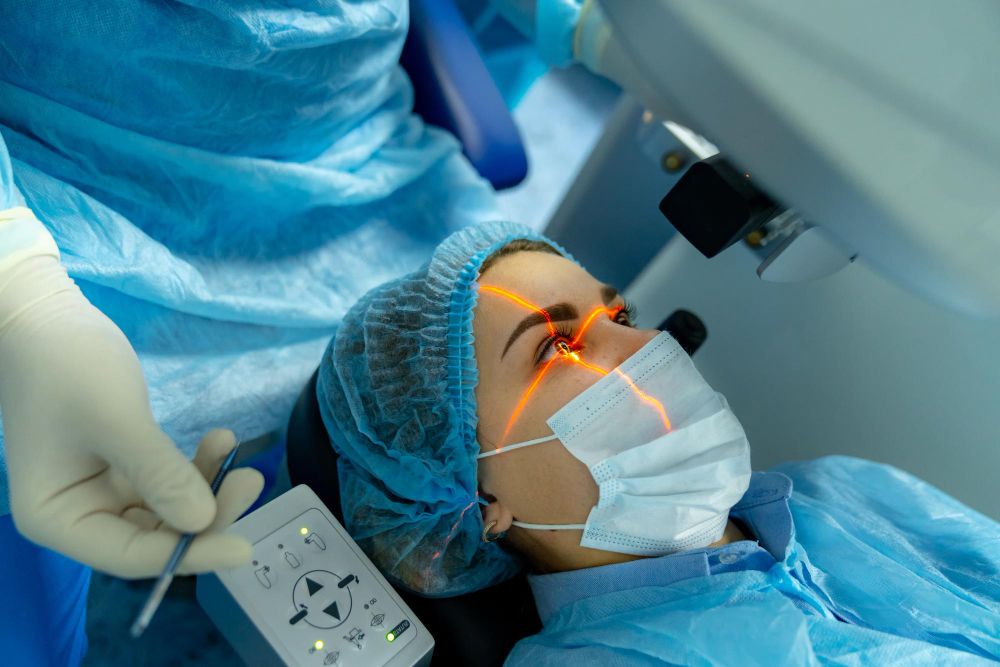
LASIK, SMILE or PRK: Which Vision Correction Procedure Is Right for You?
Glasses and contact lenses are excellent ways to correct refractive errors, but some patients prefer to reduce their dependence on them.
Modern refractive surgery offers several options, including LASIK, PRK, SMILE and Implantable Collamer Lens (ICL). However, these procedures are not interchangeable, and the best option depends on the individual’s prescription, corneal shape, corneal thickness, tear-film health, age, lifestyle and overall eye health.
The goal of refractive surgery is not simply to remove glasses. The more important goal is to select a procedure that is appropriate for the patient’s eyes and provides a safe and predictable visual outcome.
What Is LASIK?
LASIK, or Laser-Assisted In Situ Keratomileusis, reshapes the cornea using an excimer laser.
During LASIK, a corneal flap is created and moved aside. The underlying corneal tissue is then precisely reshaped using the laser before the flap is repositioned. (U.S. Food and Drug Administration)
One of the main advantages of LASIK is relatively rapid visual recovery compared with surface procedures such as PRK. However, LASIK involves creation of a corneal flap and therefore requires careful assessment of corneal structure and suitability.
What Is PRK?
PRK, or Photorefractive Keratectomy, is another laser vision correction procedure.
Unlike LASIK, PRK does not create a stromal flap. Instead, the surface epithelial layer is removed to allow the excimer laser to reshape the underlying cornea. The epithelium then heals over the treated area. (U.S. Food and Drug Administration)
Visual recovery after PRK is generally slower than after LASIK, and the early postoperative period can involve more discomfort. Vision continues to improve as the corneal surface heals and may take several weeks to months to stabilise. (EyeWiki)
PRK may be considered when a flap-based procedure is not preferred or when corneal characteristics and other factors make surface ablation a more appropriate option.
What Is SMILE?
SMILE, or Small Incision Lenticule Extraction, is a flapless laser vision correction procedure.
A femtosecond laser creates a small lenticule within the corneal stroma. The lenticule is then removed through a small incision, changing the shape and focusing power of the cornea. (AAO)
SMILE has been used primarily for myopia and myopic astigmatism, with patient selection based on the approved treatment range and individual eye characteristics.
Like LASIK and PRK, SMILE requires detailed preoperative assessment rather than being suitable simply because a patient wants freedom from glasses.
What Is ICL?
An Implantable Collamer Lens is different from LASIK, PRK and SMILE because it does not reshape the cornea.
Instead, a phakic intraocular lens is implanted inside the eye while the natural crystalline lens remains in place. ICL can be considered for selected patients, particularly those with moderate to high myopia or when corneal laser surgery may not be appropriate. (U.S. Food and Drug Administration)
Suitability depends on several factors, including age, refractive stability, anterior chamber dimensions, corneal health and overall ocular health.
LASIK vs PRK vs SMILE vs ICL
| Procedure | Basic approach | Important consideration |
| LASIK | Corneal flap + laser reshaping | Rapid visual recovery; flap-related considerations |
| PRK | Surface treatment + laser reshaping | Slower recovery; no stromal flap |
| SMILE | Small incision + lenticule extraction | Flapless procedure; primarily used for myopia/myopic astigmatism within approved indications |
| ICL | Lens implanted inside the eye | Does not remove corneal tissue; requires intraocular surgery |
There is no universally “best” procedure. The appropriate choice depends on the individual patient.
What Happens Before Refractive Surgery?
A detailed preoperative assessment is one of the most important parts of refractive surgery.
Your ophthalmologist may assess:
- Current and previous spectacle prescription
- Stability of refractive error
- Corneal topography and tomography
- Corneal thickness
- Tear-film and dry-eye status
- Pupil characteristics
- Eye pressure
- General ocular health
- Retinal health where appropriate
- Previous eye surgery or injury
- Medical conditions and medications
Contact lens wear can temporarily alter corneal shape, so patients may need to stop wearing lenses before certain measurements are taken. (U.S. Food and Drug Administration)
Who May Not Be Suitable?
Refractive surgery is not appropriate for everyone.
Factors that may affect suitability include unstable spectacle power, significant dry eye, thin corneas, abnormal corneal shape, certain systemic or ocular conditions, previous eye surgery and other factors affecting healing. Keratoconus is particularly important to identify before corneal laser surgery. (U.S. Food and Drug Administration)
This is why a proper evaluation is more important than choosing a procedure based on advertising, price or someone else’s experience.
What About Risks?
Refractive surgery has a strong safety record in appropriately selected patients, but no surgical procedure is completely risk-free.
Possible complications and side effects can include dry eye, glare, halos, fluctuating vision, residual refractive error, under-correction or over-correction and, less commonly, more serious complications affecting vision. (U.S. Food and Drug Administration)
Some patients may still require glasses or contact lenses after surgery. The FDA also emphasises that there are no guarantees that every patient will achieve 20/20 vision. (U.S. Food and Drug Administration)
Which Procedure Is Right for You?
The answer should come after your eye examination, not before it.
A patient with a suitable cornea may be considered for LASIK, PRK or SMILE. Another patient with a high refractive error or corneal characteristics that make laser treatment unsuitable may be considered for an ICL. Some patients may not be suitable for refractive surgery at all.
At Pristine Eye Clinic, the emphasis is on detailed preoperative assessment, identifying potential risk factors and selecting the procedure based on the individual patient’s eyes, visual needs and safety considerations.